Arctic sea ice 2026: a cooler summer did not erase the long decline
New October analyses explain why Arctic sea ice’s annual minimum and September average give different rankings, while the ice remains below its long-term baseline.
In this article
Key points
- The 12 September minimum was about 4.6 million square kilometers, tied for tenth lowest.
- September’s monthly average was 4.81 million square kilometers, ranked thirteenth lowest.
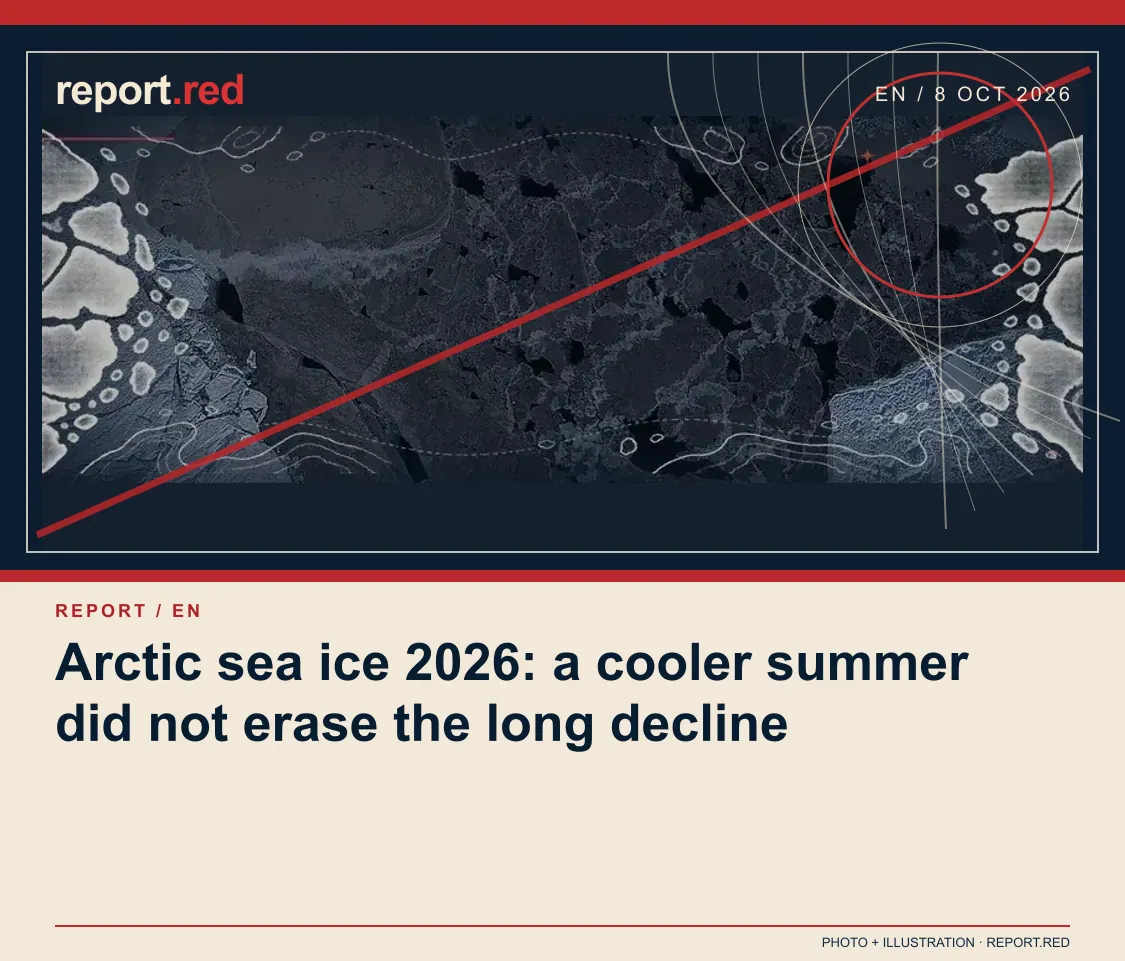
A relatively cool, stormy Arctic summer helped slow melting in 2026, but it did not return the ice to its historical baseline. New analyses published on 7 October by NASA Earth Observatory and the National Snow and Ice Data Center describe both that weather influence and a continuing long-term decline. The cover blends the real photograph with an editorial illustration by report.red.
Two measurements, two rankings
The year’s lowest daily extent occurred on 12 September at about 4.6 million square kilometers. The analyses place it in a tenth-lowest tie with 2008, 2010 and 2025 in the satellite record.
NSIDC puts the average for the entire month of September at 4.81 million square kilometers, the thirteenth lowest. That monthly average was 1.6 million square kilometers below the 1981–2010 average. These numbers describe different periods; the rankings do not contradict one another.
What weather can change, and what it cannot show alone
NSIDC describes persistent low pressure, cloudiness and cooler conditions over the Arctic Ocean that inhibited summer melt. Ice expanded rapidly after the September minimum. A season’s weather therefore matters when comparing one year with another.
The longer record tells a different story: the September downward trend is 11.6 percent per decade relative to the 1981–2010 average, in NSIDC’s analysis through 2026. NASA also describes a cover increasingly dominated by younger, thinner ice.
A better ranking than the record-low year is not evidence that the long decline has reversed. Extent measures the spread of sea ice, not its thickness; the October reports need to be read alongside those distinctions, rather than reduced to a single ‘record’ headline.
Historical aerial photographic mosaic of Arctic sea ice from NASA’s Operation IceBridge, 2 April 2012. It does not show the September 2026 ice extent. Resized and converted to WebP without cropping. Photo credit: NASA / Digital Mapping System team, Operation IceBridge. Photo credit · Public domain in the United States (NASA); editorial reuse under NASA Media Usage Guidelines