NASA’s two new relay demonstrations reach orbit: launch success comes before the connectivity test
Viasat and SES will test different satellite relay routes after the Bandwagon-5 launch. The demonstrations support NASA’s planned shift from its ageing TDRS fleet, with testing continuing through 2027.
In this article
Key points
- NASA reported two funded demonstrations launched on 20 October; communications performance results are still ahead.
- Viasat plans a route through geosynchronous satellites; SES will combine medium-orbit high-rate links with geosynchronous low-rate links.
- The $278.5 million figure refers to 2022 industry awards across the project, not the price of this launch.
NASA says two commercially developed communications demonstrations reached low Earth orbit on SpaceX’s Bandwagon-5 rideshare on 20 October 2026. Their next job is to test how spacecraft can pass both large data streams and basic command signals through commercial satellite networks. Reaching orbit is the completed milestone; the announcement places the communications demonstrations in the coming weeks, with no performance results yet reported. [1]
Two routes to the same practical problem
A science spacecraft needs more than a fast download connection. High-rate links carry large files, including scientific data and imagery, while lower-rate links support tracking and commands. A replacement relay service must address those different needs rather than demonstrate speed alone.
Viasat will use Maxwell, a demonstration spacecraft built by Rocket Lab, to test high- and low-rate services. NASA describes autonomous routing between Maxwell, Viasat’s geosynchronous satellites and ground stations. SES Space and Defense will test a different combination: O 3 b mPOWER satellites in medium Earth orbit for high-rate traffic and geosynchronous satellites for low-rate traffic. These are intended capabilities being tested, not evidence that uninterrupted service has already been achieved. [1]
Why NASA is testing commercial relays
The work supports a gradual move away from NASA’s Tracking and Data Relay Satellite fleet for future low Earth orbit missions. The agency’s broader commercial communications programme separates several tasks, including space relays and ground antennas. The new flights address the relay part of that transition; they are not an announcement that every NASA communications system has been replaced. [2]
NASA’s launch report cites $278.5 million awarded to industry in 2022 through the Communications Services Project. That is a historical programme funding figure, not a disclosed launch cost for Bandwagon-5 or a price for either individual spacecraft. Keeping the denominator clear matters when assessing the scale of the two demonstrations. [1]
What to watch after launch
The useful next evidence will be test results showing how high- and low-rate services perform across the different network routes. NASA says the Glenn Research Center-managed project will continue relay testing with industry through 2027. That is a programme horizon, not a promise that these two flights alone will establish a fully operational replacement on a particular date.
This report draws on NASA’s launch account and programme description. Those pages are statements from the same agency, rather than independent confirmation of network performance. Neither page supplies a new measured service-availability figure, so no such figure is asserted here.
More science reporting from report.red
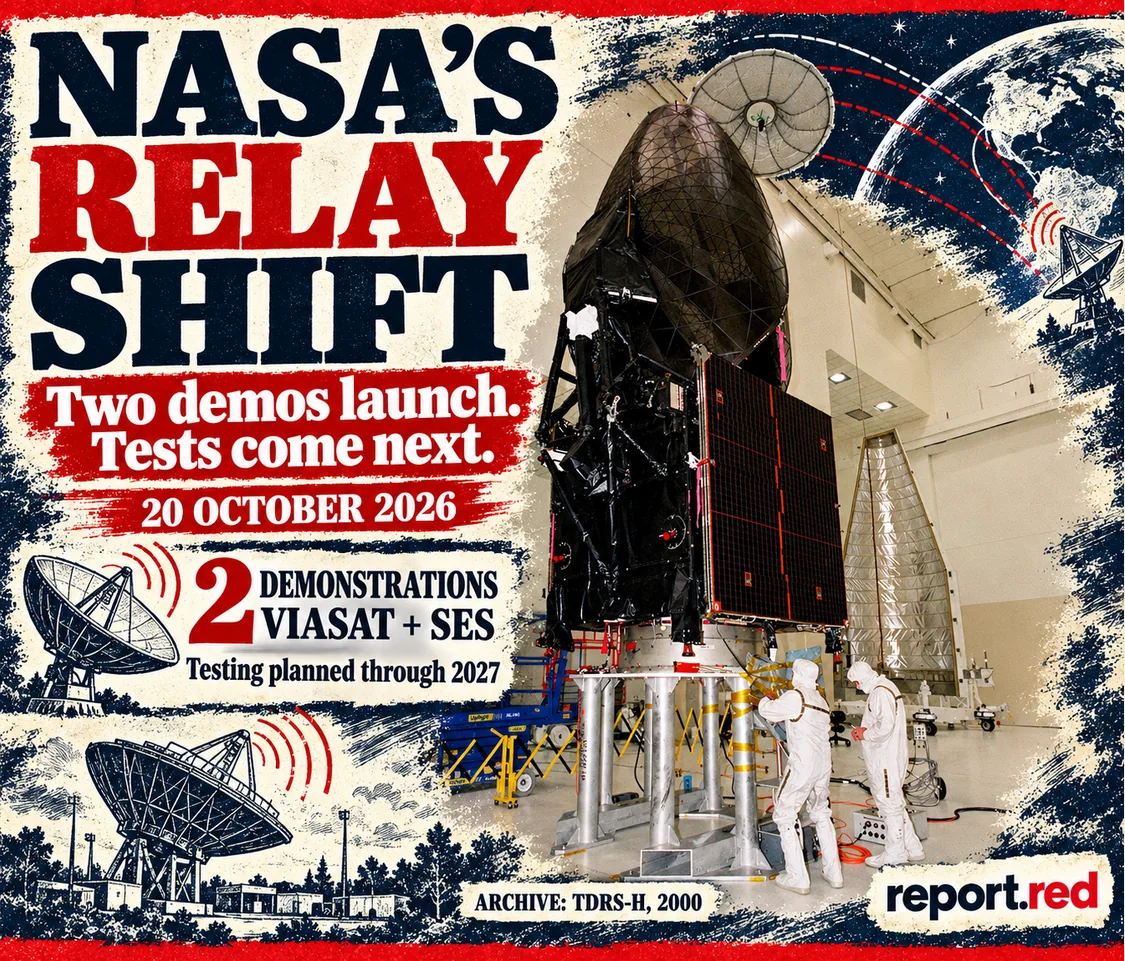
Archive photograph, 2000: TDRS-H undergoing preparation for electrical testing at Kennedy Space Center. It shows the legacy relay system, neither new demonstration spacecraft nor the 2026 launch. Drawn diagrams are illustrations NASA Kennedy Space Center · Public domain. ImageGen / report.red.