Europe’s RAISE pledges put AI tools on the research agenda; access terms are the next practical test
The Commission’s new initiative pools voluntary contributions of models, computing, data and training. Researchers should distinguish a company’s pledge from an available entitlement, and check each route to access.
In this article
Key points
- The initiative page dates the Dublin launch to 15 October 2026
- Contributions include computing, models, software, datasets and training
- Published pledges do not create a universal application or guarantee of access
European researchers have a new collection of promises for AI resources to examine: the Commission’s RAISE AI in Science Enablers initiative brings together industry and philanthropic contributions ranging from computing capacity to model access and training. The useful question for a laboratory is which of those promises can become an accessible resource for its work, under what conditions. The initiative’s own page dates its launch in Dublin to 15 October 2026. [1]
Different resources solve different bottlenecks
The published contributions cover several stages of research. A team may need computing to run a model, rights to use a dataset, software to analyse results or training to make a workflow reproducible. The initiative pools those capabilities through voluntary contributions; it is broader than a single cash grant or a common software subscription.
The initial organisations listed are Elsevier, Frontiers, Google, Mistral, the Novo Nordisk Foundation, NVIDIA and Sanofi. Their commitments have different forms. For example, the initiative page describes Google’s US$3 million in cloud credits or tokens, while the Novo Nordisk Foundation intends to make capacity on the Gefion supercomputer available. Those descriptions should not be added together as if every item were cash paid to researchers, or treated as immediately usable by every European team.
A pledge is the beginning of an access check
Before budgeting a project around a contribution, researchers should identify the provider’s application route, eligibility, available allocation and duration. They should also check data handling, licence conditions and whether work can continue after credits or seats expire. These are practical questions for assessing the offer; the Commission’s announcement does not answer them with one shared entitlement.
The Commission says participating organisations must demonstrate sustained support beyond their direct commercial interests, and that pledges and progress will be reviewed annually. That creates a stated mechanism for follow-up, but it does not yet demonstrate how many researchers will obtain usable resources or what scientific results will follow. [2]
Keep the launch date and the evidence limits visible
The dedicated initiative page says the launch took place on 15 October at the European AI in Science Summit in Dublin. The companion press release displays 14 October, and the initiative page also carries 14 October metadata. We use the explicitly stated event date for the launch, while preserving the differing document dates in our source record.
This report is a reading of two Commission pages, rather than independent verification of the companies’ delivery. The initiative may widen access to useful tools; a scientific breakthrough, a completed allocation or a guaranteed award is a different claim and is not established by these pledges.
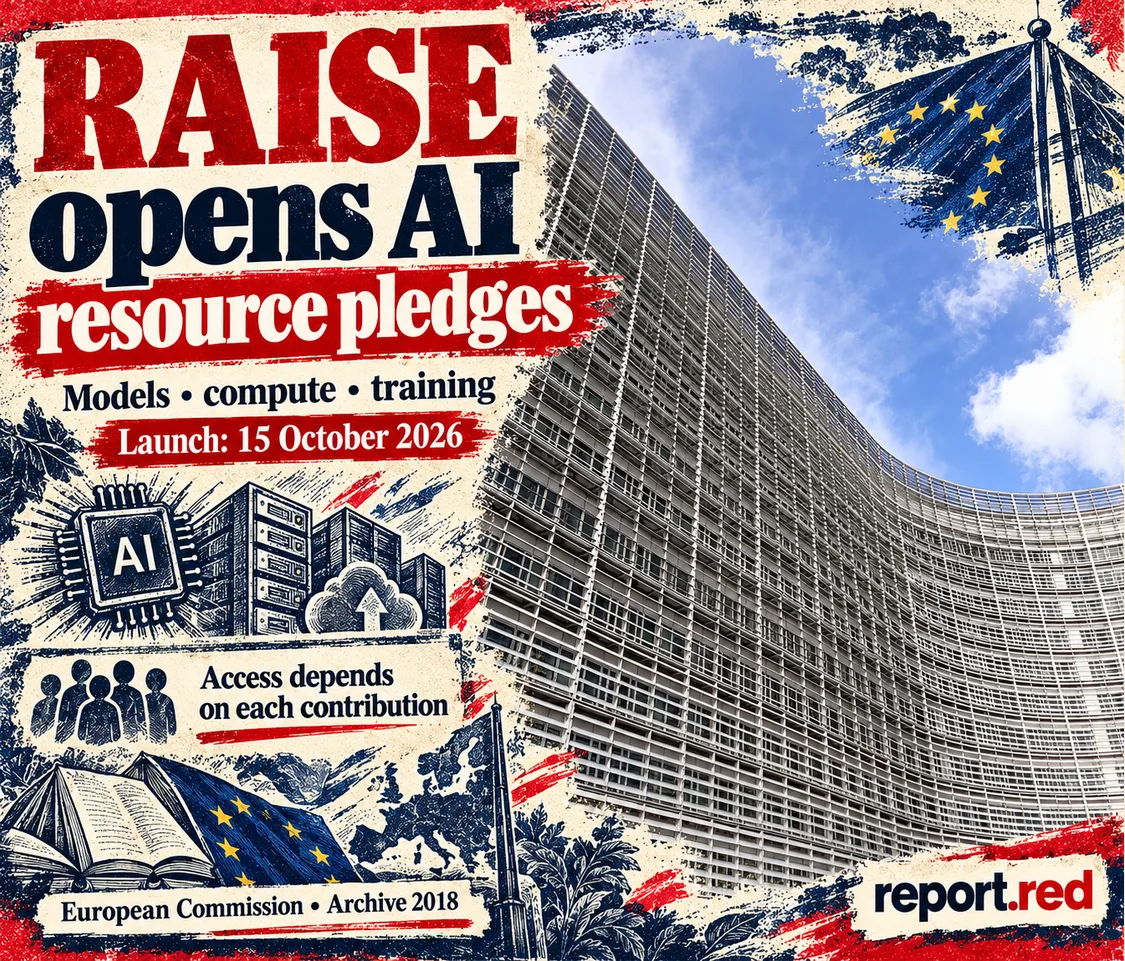
Cover collage uses a 2018 archive photograph of the Berlaymont in Brussels as European Commission context. It does not show the Dublin launch. Photo by acediscovery · CC BY 4.0. ImageGen / report.red.